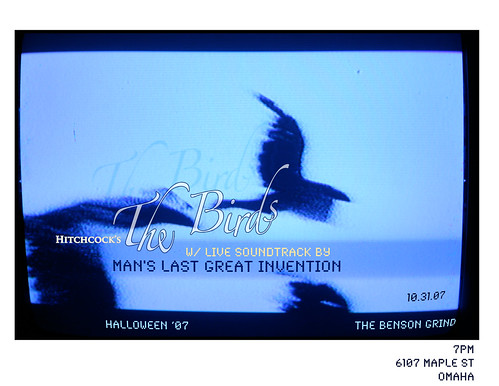
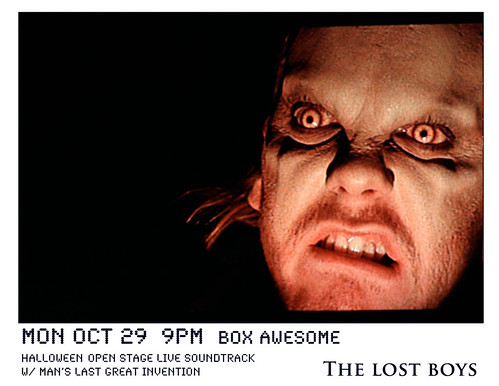
Also, you should go to the Clean Part tomorrow night. 7 PM at the Sheldon.
Cynthia Arrieu-King! Jason Bredle! Jen Tynes!
(Emphasis theirs, though I agree)


Kitchen Press & Cannibal Books
invite you to eat from the chopping block
w/
Erin Elizabeth Burke Run Down the Emphasis (Kitchen)
Thibault Raoult I'll Say I'm Only Visiting (Cannibal)
Mathias Svalina Why I Am White (Kitchen)
Friday, November 2nd, 8 PM
Unnameable Books
456 Bergen Street
btwn. 5th & Flatbush
Refreshments served, but you may also BYOB.
Kitchen Press and Cannibal Books products will be available for consumption.
Unnameable Books carries an excellent selection of poetry from independent presses.
This event is free for all.


Poetry Out Loud
Reading series brings in some of the nation’s best
by Avishay Artsy
Sometimes it takes free peanuts and pie to get people to listen to contemporary poetry.
When Mathias Svalina and Zachary Schomburg began directing The Clean Part Reading Series in 2005, audiences at Lincoln’s Tugboat Gallery cracked open peanuts and tossed shells on the floor. Raffle tickets were handed out for a pie, which sat in its box atop the lectern until just before the final reading. Then a lucky winner, usually a hapless undergraduate required to attend, would have his or her photo taken with the two beaming organizers.
“We don’t have pies anymore. It’s actually regressed,” Svalina said, laughing. “It used to be a lot cooler, apparently.”
Readings are now held at the University of Nebraska-Lincoln’s Sheldon Memorial Art Gallery. Featured poets are still taken out for post-reading pizza and beer. The two believe it’s a way to foster kinship between poetry enthusiasts in Lincoln and up-and-coming poets across the country.
The series quickly developed a positive reputation. Despite having no money to reimburse visiting poets, “literally, within two months, people were emailing us to see if they could travel here to read,” Svalina said.
The dozen Clean Part readings have attracted small, intimate crowds. Svalina and Schomburg acknowledge modern poetry’s limited appeal.
“It’s for 50 people. It’s not for the world. And that’s OK,” Svalina said. While poets might sell a handful of books at the readings, he said, “every single copy of that is going to be read more deeply, and better, than any copy of a Michael Crichton book is ever going to be read.”
Svalina and Schomburg are completing doctoral studies in creative writing at UNL, and teach undergraduate classes. The two publish Octopus Magazine, an online journal of poetry reviews and essays. They run the small press Octopus Books.The set of 8 chapbooks from Octopus is, I hear, in very limited supply at this point.
Schomburg, 30, began the online magazine in 2003 with a friend, notable poet Tony Tost. After moving to Lincoln in the fall of 2005, Schomburg recognized Svalina’s name from the magazine’s rejection list, “because it was an interesting name. It was a name that I would have wanted on the page, because it looked good.” He asked Svalina, 32, to become co-editor.
“We had the same ideas about poetry, what poetry could do,” Schomburg explained. The book imprint and reading series soon followed.
This has been a year of firsts for them. Schomburg’s debut collection, The Man Suit, was published in April by Black Ocean Press. The cast of talking animals and dead presidents earned Schomburg an appraisal as “one of the sincerest surrealists around” from Publishers Weekly. Svalina’s first chapbook, Why I am White, was released in August by Kitchen Press. His second publication, Creation Myths, came out this month after winning New Michigan Press’s annual chapbook competition.
Seriously, there's no reason not to own these.
Both poets create highly imaginative alternate realities, in which action defies logic; and truth, as we understand it, is turned on its head. In Creation Myths, Svalina toys with the world’s genesis, imagining a pen that drew the world into existence, or a boy cutting the world out of colored paper. Other explanations involve hovercrafts, explosions, paper clips and a mummy.
Mythology figures into Schomburg’s poems, in which Abraham Lincoln shoots himself in the head and William McKinley plays piano while falling from the sky.
“I think that history is a lot more fun than the actual one that just happened,” Schomburg said, “so why not play with that?”
When Svalina writes “In the beginning people had cornfields rather than sex parts,” and when Schomburg writes, “At a Halloween party, a lung went as a haircut, and a haircut went as a lung,” both writers show that the perceived is more important than the actual.
“[William] Blake said, ‘the imagination is real.’ Blake’s right. What we imagine is true,” Svalina said.
In The Man Suit, Schomburg writes, “Let’s bring everything that’s inside, outside.”
Poets share a sometimes-obsessive need to communicate, and by offering poetry enthusiasts a venue for cutting-edge writing, the two hope to translate what Schomburg calls the “indefinable chaos” of the world into something that can be understood.


Christian Hawkey. Citizen Of. Wave Books, 2007.
Review by Mathias Svalina
Within a limited set of parameters, with a limited way of defining this & at the risk of courting hyperbole I want to tell you that Christian Hawkey is a superhero. Christian Hawkey can do things in poems that normal humans can not do. Witness:
…some creatures move
a few inches every time they blink
I opened my eyes you were my wife
hand a little lower on my spine
although always the smell of tire
burning through the night some creatures
move a few inches each time they flinch
Witness:
At night the jaws of turtles creak open
to collect rain, heat lightning
reflected in their wide, sad eyes.
A tear falls. A turtle tear! Two musk deer
shiver across a meadow, dusk
a brief firefight, our names
appear & disappear, like that.
Alison I stored in a bottle in the ground.
I'm standing on a love song. I can hear it tick.
Witness:Then she removed
her Donald Duck
mask &
lay with me,
down, in the
field from which
my mind was waving
to her.If you’re not Christian Hawkey you simply cannot do that. I know. I know that you think you can, but you can’t. I’m sorry. You do not have the super powers.Even The New Yorker's Briefly Noted took note:
All three of these are dazzling displays of evocative leaping, yet they do not flail, no strings dangle from their seams. They are gemlike in their precise refraction of ecstatically wild associations. They create a world in which anything is possible, so long as it stays close to the skin & immediately accessible for an individual speaker.
But these are hardly isolated incidents of poetic heroics. Open Citizen Of to any page & randomly drop your finger down. You’ll find another one & it will clutch you & invite you to continue reading. It’s a bibliomantic divination process, but rather than auguring the future it ostends toward poetry that jumps off the page & squirms through your sheets.
Much of Hawkey’s surreal dazzle is predicated by the individual’s emotional experience. The sentimental functions as a tether to keep the surreal from clambering off to go roll around in something stinky. Yet this is a book that focuses us from the title to the role of the individual within a state. It is a book that refuses to ignore politics while at the same time remaining aesthetically unwilling to engage in a traditional kind of political debate.The title of this collection serves as a challenge to readers in a political climate where alarmism seems to alternate with complacency. “Hour with One Hand Inserted in a Time of War” asks, “Should we / stand guard at the Level of One Hand Raised / to Block the Lemon Seed of the Sun / or should we push off, down the tunnels, / dig a hole in the side of a wall & wait?” Hawkey effectively conjures a contemporary scene that seems peaceful, even while “Landmines whisper sideways underground.” Everyone, he says, is “no longer / a crow’s nest but a cluster of nests, / urban, suburban, some with turbans.” Humor, stemming more from exasperation than from delight, eases immersion into the tight-knit poems, but amid the laughter a loud alarm rings: “At least the bird’s brain was focused / on something."



Slightly offbeat in a laid-back way — the Wes Anderson of the accessory world — the youthful tie is giving the old dress code a much-needed shot in the neck.

We get lost in the desert, lost very lost, and although we aren't
going to tell anyone that we can't possibly be any more than two miles
from civilization, the fact remains that we are lost very lost in the
desert very desert, and the car very car is having a hard very hard
very hard time getting started up again, and so we kick it very kick
it in its ass very ass and the car is still having a hard very hard
time and we are feeling lost all the more lost very lost in this
desert very desert, and there is no one around us no no one very
around us at all very all and there are birds very birds of which
there are many very many, but the birds very birds don't know don't
know how to help us and us and us help start the car very car and we
are more lost more lost and we need help need very very help need very
very help help and there is no no no one aroud us except if you count
count count those ants in the ant hill that is all we have all we have
are the ants very ants and then we wire them up yes wire them up yes I
said wire wire wire and with the force of all the ants all wired all
wired up and then on the count of three we all yell "CHARGE!"

In fact, only about 1.5 percent of federal transportation dollars go to fund bike paths and walking trails. In the meantime, 10 percent of all U.S. trips to work, school and the store occur on bike or foot, and bicyclists and pedestrians account for about 12 percent of annual traffic fatalities, according to the Federal Highway Administration. "We represent a disproportionate share of the injuries, and we get a minuscule share of the funds," says Robert Raburn, executive director of the East Bay Bike Coalition in the San Francisco Bay Area, who calls the Peters' comments "outrageous." Plus, he notes, with problems like global warming, the obesity epidemic and energy independence, shouldn't the U.S. secretary of transportation be praising biking, not complaining about it?...
What really drives cyclists around the bend is that while they're doing their part to burn less fossil fuel -- cue slogan: "No Iraqis Died to Fuel This Bike" -- they're getting grief for being expensive from a profligate administration. "War spending, tax cuts for the rich, and gas taxes are all big sources of funding. Bike spending is not," fumes Michael Bluejay, an Austin, Texas, bike activist, in an e-mail. "The few pennies we toss toward bike projects is not enough to fix our nation's bridges, not by a freaking long shot."